


Soft Washing Cedar Shake and Shingles Without the Stress
Your Roof Is Trying to Tell You Something
Soft washing asphalt shingles is the safest, most effective way to remove algae, moss, and black streaks from your roof without damaging the shingles or voiding your warranty.
Here’s the quick version of how it works:
- Inspect the roof for biological growth and existing damage
- Protect surrounding plants and landscaping with pre-wetting
- Apply a low-pressure sodium hypochlorite solution to the shingles
- Allow dwell time so the solution kills growth at the root
- Rinse gently with low pressure (under 500 PSI)
- Inspect again to confirm results
Look up at your roof right now. See those dark streaks running down the shingles? That’s not just dirt. It’s a living organism — and it’s slowly eating your roof.
Those black marks are almost always caused by Gloeocapsa magma, a cyanobacterium that feeds on the limestone filler inside asphalt shingles. Left alone, it breaks down the shingle material from the outside in. Moss and lichen make things worse by trapping moisture and lifting shingle edges.
The result? A roof that ages years faster than it should.
The good news: you don’t need high-pressure blasting to fix it. In fact, pressure washing can cause more damage than the algae itself — stripping the protective granules right off your shingles.
That’s exactly why soft washing exists. It uses chemistry instead of force to clean your roof safely and keep it clean longer.
For busy Richmond-area homeowners, this matters a lot. Our humid summers and tree-heavy neighborhoods create the perfect conditions for algae and moss to spread fast. Ignoring it doesn’t just hurt curb appeal — it can shorten a roof’s lifespan by years and even trigger issues with your homeowner’s insurance.
What is Soft Washing Asphalt Shingles and Why Does It Matter?
If you’ve ever used a pressure washer to clean a concrete driveway, you know how satisfying that “blast” can be. But using that same force on your roof is like using a sandblaster to wash your favorite sweater—it’s going to end in tears (and a very expensive repair bill).
Soft washing asphalt shingles is a cleaning method that prioritizes chemistry over brute force. Instead of relying on high-pressure water to rip away stains, we use a specialized, low-pressure delivery system—often operating at less than 100 PSI, which is comparable to the pressure of a standard garden hose.
The secret sauce is the cleaning solution. We use a mixture of sodium hypochlorite (the active ingredient in bleach), water, and surfactants. The sodium hypochlorite acts as a biocide, killing algae, mold, and mildew at the root. The surfactant helps the solution “stick” to the shingles, ensuring it doesn’t just slide off into your gutters before it can do its job.
Why does this matter? Because your shingles are delicate. They are composed of a fiberglass mat coated in asphalt and topped with ceramic-coated mineral granules. These granules are your roof’s first line of defense against UV rays and fire. High-pressure washing (which typically runs between 1,500 and 4,000 PSI) can easily dislodge these granules, leaving the underlying asphalt exposed to the sun, which leads to cracking, curling, and premature failure.
The Asphalt Roofing Manufacturers Association (ARMA) is very clear on this: they recommend low-pressure chemical cleaning and warn that high-pressure washing can void your roof’s warranty. When we perform Residential Roof Cleaning, we follow these industry standards to the letter to ensure your home stays protected.
Soft Washing vs. Pressure Washing: The Comparison
| Feature | Soft Washing | Pressure Washing |
|---|---|---|
| Pressure Level | Under 100 – 500 PSI | 1,500 – 4,000 PSI |
| Cleaning Agent | Specialized Biocides & Surfactants | Mostly Water (sometimes soap) |
| Risk of Damage | Extremely Low | High (Granule loss, leaks) |
| Longevity | Lasts 4-6x longer | Short-term results |
| Warranty Safe? | Yes (Recommended by ARMA) | No (Often voids warranties) |
| Water Usage | 1/3 to 1/2 less water | High volume |
The Science Behind Black Streaks and Roof Growth
We often hear homeowners in Midlothian or Glen Allen ask, “Why is my roof turning black? Is it soot from the highway?” Usually, the answer is more biological than industrial.
The primary culprit for those unsightly black streaks is Gloeocapsa magma. This is a type of hardy algae that thrives in warm, humid environments—exactly what we experience during a Central Virginia summer. This algae has a clever (but destructive) survival strategy: it feeds on the limestone filler used in modern asphalt shingles. As the algae eats the limestone, it leaves behind a dark, pigment-heavy protective coating to shield itself from UV rays. That’s the “streak” you see.
But it’s not just an aesthetic issue. These streaks:
- Absorb Heat: Dark streaks turn your roof into a giant heat sink, raising attic temperatures and driving up your cooling costs.
- Retain Moisture: Algae, and eventually moss and lichen, hold onto water. This constant dampness can rot the underlying roof deck.
- Invite Friends: Once algae establishes a foothold, it creates a fertile environment for moss and lichen. Moss is particularly dangerous because its roots (rhizoids) can lift the edges of shingles, allowing wind-driven rain to get underneath and cause leaks.
Lichen is another heavy hitter. It’s a symbiotic relationship between algae and fungus that actually “roots” into the shingle granules. If you try to scrape lichen off, the granules usually come with it. Soft washing is the only way to kill these organisms without taking pieces of your roof with them.
For those interested in the technical safety of our cleaning agents, the U.S. EPA Sodium Hypochlorite Fact Sheet provides extensive data on how this compound works as an effective antimicrobial agent while breaking down safely in the environment.
Step-by-Step Guide to Soft Washing Asphalt Shingles Safely
While it might look like we’re just “spraying the roof,” a professional soft wash is a calculated process. Here is how we handle soft washing asphalt shingles for our neighbors in Chesterfield and Henrico.
1. Site Assessment and Safety Setup
Before any water touches the roof, we perform a pre-inspection. We look for loose shingles, damaged flashing, or areas where water might intrude. Safety is our top priority, so we adhere strictly to OSHA Fall Protection Standards to protect our technicians and your property.
2. Landscaping Protection
This is the step many DIYers skip, and it’s the most important for your curb appeal. Sodium hypochlorite is great at killing algae, but it doesn’t distinguish between “bad” algae on the roof and “good” hydrangeas in your garden.
- Pre-wetting: We saturate all grass, shrubs, and flowers with plain water before we start. This creates a protective barrier so the plants can’t absorb the cleaning solution.
- Covering: Sensitive plants may be covered with light tarps.
- Runoff Management: We often bag downspouts to collect any concentrated runoff.
3. Mixing the Solution
We don’t use a “one size fits all” mix. Depending on the severity of the growth, we mix our solution on-site. For light stains, a 1-3% concentration of sodium hypochlorite is usually sufficient. For heavy moss or lichen, we may move toward a 4-6% mixture. We always add a professional-grade surfactant to ensure the mix stays where it’s needed.
4. Application
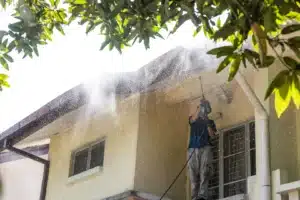
Using a specialized soft wash pump, we apply the solution from the bottom up to prevent “clean streaks” and ensure even coverage. We don’t use brushes or scrapers; we let the chemistry do the heavy lifting.
5. Dwell Time
The solution needs time to work—typically 15 to 30 minutes. You’ll actually see the black streaks disappear before your eyes as the algae dies. Moss and lichen will turn white or yellow, signaling that their root systems have been neutralized.
6. The Gentle Rinse
Once the biological growth is dead, we rinse the roof with a high-volume, low-pressure stream of water. We also perform a final rinse of the entire house and all surrounding landscaping to ensure no solution remains on your plants or siding.
When done correctly, Residential Soft Washing leaves your roof looking brand new without a single granule out of place.
Financial and Structural Benefits of Roof Maintenance
Is soft washing asphalt shingles an expense or an investment? When you look at the numbers, it’s clearly the latter.
1. Lifespan Extension The average cost of a roof replacement in the Richmond area can range from $8,000 to $15,000 or more. Research shows that regular soft washing can extend the lifespan of your roof by 5 to 15 years. By spending a few hundred dollars on maintenance every few years, you can delay a five-figure replacement cost for a decade.
2. Energy Efficiency A clean roof is a reflective roof. By removing the dark algae streaks that absorb solar heat, you can reduce your attic temperature significantly. This means your AC doesn’t have to work as hard during those 90-degree July days in Mechanicsville, leading to lower utility bills.
3. Insurance Compliance This is a growing concern for many homeowners. Insurance companies are now using drones and satellite imagery to inspect properties. If they see significant moss or algae growth, they may issue a notice of non-renewal or require a professional cleaning to maintain coverage. Keeping your roof clean ensures you stay in compliance with your policy.
4. Warranty Protection As mentioned, ARMA and most shingle manufacturers (who follow ASTM D3462 standards for shingle construction) specify that high-pressure washing voids the warranty. Soft washing is the only approved method that keeps your manufacturer’s protection intact.
For business owners, these benefits apply to your facilities as well. Our Commercial Building Washing services help maintain property value and professional appearance for local businesses across Central Virginia.
Frequently Asked Questions About Soft Washing Asphalt Shingles
Does soft washing asphalt shingles remove protective granules?
Absolutely not—in fact, it’s the only way to avoid removing them! High-pressure washing acts like a “water-pick” that can blast the ceramic granules right off the asphalt mat. Soft washing uses a chemical reaction to dissolve the “glue” that algae uses to stick to your roof. Because we use pressure lower than a typical rainfall, your granules stay exactly where they belong.
How often should you perform soft washing asphalt shingles?
For most homes in the Greater Richmond area, a maintenance cycle of every 18 to 36 months is ideal. However, this can vary based on your environment. If your home is in a heavily shaded area (like many parts of Bon Air or Ashland) or has a north-facing roof slope that rarely sees the sun, you might need a touch-up sooner. Keeping an eye out for the first sign of dark “shadows” on the roof is a good way to stay ahead of the growth.
Is the solution used in soft washing asphalt shingles safe for plants?
Yes, when handled by professionals. While the concentrated solution can be harmful to plants, our process of pre-soaking the landscaping, using biodegradable surfactants, and performing a thorough post-rinse makes the risk negligible. By the time the solution reaches your soil, it is highly diluted and breaks down into simple salt and water.
Conclusion
Your home is likely your biggest investment, and the roof is its most important shield. Neglecting those black streaks isn’t just a matter of “bad curb appeal”—it’s allowing biological growth to slowly dismantle your shingles.
At Alpha Exterior Solutions, we specialize in soft washing asphalt shingles for homeowners throughout Richmond, Midlothian, Short Pump, and the surrounding counties. Our award-winning reliability and eco-friendly methods mean you get a roof that looks brand new without the stress of potential damage.
Don’t wait until a small algae problem becomes a major leak. Whether you’re in Hanover or Goochland, we are here to help you protect your home.
Ready to see your roof shine again? Contact us for Residential Soft Washing today!

