


Gentle Pressure Washing 101
What Is Low Pressure Power Washing (and Why It’s Better for Your Home)?
Low pressure power washing — also called soft washing — is a gentle cleaning method that uses water at 100–1,000 PSI combined with biodegradable cleaning solutions to safely remove dirt, mold, algae, and mildew from exterior surfaces.
Here’s a quick breakdown of why it matters:
| Feature | Low Pressure Washing | High-Pressure Washing |
|---|---|---|
| PSI range | 100–1,000 PSI | 2,000–5,000 PSI |
| Safe for siding, roofs, stucco? | Yes | Often not |
| Removes mold and algae? | Yes, kills at the root | Removes surface only |
| Risk of surface damage | Low | High |
| Water usage | ~25% less overall | Higher |
Most homeowners assume more pressure means a deeper clean. It doesn’t. In fact, high-pressure blasting can punch holes in vinyl siding, strip paint, force water behind walls, and shorten the life of your roof — all while leaving behind the mold spores that caused the problem in the first place.
Low pressure washing solves the actual problem. The cleaning agents do the heavy lifting, not the water force.
I’m a professional exterior cleaning specialist serving the Greater Richmond area, with hands-on experience applying low pressure power washing techniques to homes and commercial properties throughout the region. In this guide, I’ll walk you through everything you need to know to protect your home’s exterior the right way.

Low Pressure Power Washing vs. High-Pressure Blasting
When people think of cleaning their driveway or siding, they often picture a “water blaster” that could strip the bark off a tree. While that raw power has its place—mostly on unpainted, porous concrete—it is often the enemy of your home’s delicate exterior.
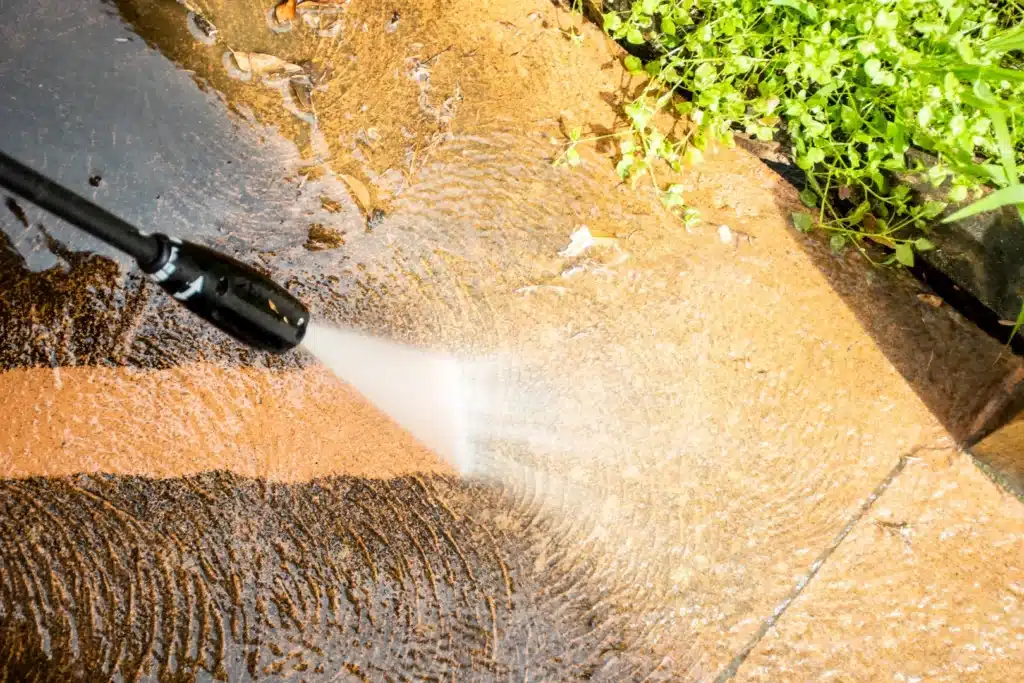
Traditional Residential Pressure Washing typically operates between 2,000 and 5,000 PSI. At these levels, the water acts like a physical chisel. If you’ve ever seen a sidewalk that looks like a child drew permanent lines all over it, you’ve seen the “scarring” effect of high-pressure water used incorrectly. On siding, this force can easily punch holes in vinyl, shatter window seals, or blast the protective granules off your roof shingles.
In contrast, low pressure power washing operates in a much safer range, typically between 600 and 1,000 PSI for the cleaning phase, and as low as 100 PSI for the application phase. Instead of relying on a narrow, high-velocity stream to “rip” dirt off, we use a wide fan spray that gently bathes the surface.
One of the biggest risks of high-pressure methods is water intrusion. High-pressure jets can force water behind your siding or into your attic vents, leading to hidden mold growth inside your walls. Because we use a lower PSI, we significantly reduce the risk of forcing water where it doesn’t belong. We aren’t just cleaning the surface; we’re protecting the structural integrity of your home in Richmond or Midlothian.
The Science of Soft Washing: Detergents and Sterilization
If we aren’t using high pressure to blast away the grime, how does the surface get clean? The answer lies in chemistry. Low pressure power washing relies on a process called “soft washing,” where specialized detergents do the heavy lifting.

The process starts with a custom-blended cleaning solution. This usually includes:
- Surfactants: These are “soaps” that help the water stick to vertical surfaces rather than just running off. Think of it like the difference between water and syrup; the surfactant ensures the cleaner stays exactly where the mold is.
- Sodium Hypochlorite: A powerful but safe disinfecting agent that kills organic growth at the root.
- Biodegradable Buffers: To ensure the solution is safe for your landscaping and the environment in Central Virginia.
Once applied, we allow for “dwell time”—usually between 8 and 12 minutes. During this time, the solution seeps into the microscopic pores of your siding or roof shingles. It doesn’t just wash away the green algae you see; it sterilizes the surface, killing the spores so they don’t grow back next month. This is why Residential Soft Washing results can last 4 to 6 times longer than traditional pressure washing.
The Mechanics of Low Pressure Power Washing
To achieve this gentle but effective clean, we use specific equipment configurations. The most important factor isn’t actually the pressure (PSI), but the volume of water, measured in Gallons Per Minute (GPM).
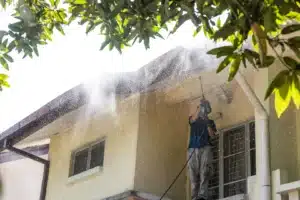
Professional systems often use “fan spray” nozzles, specifically the “black tip” designed for soap application. These nozzles create a wide, gentle mist that can reach the second or even third story of a home in Short Pump or Glen Allen from the safety of the ground. By standing several feet back and using a high GPM/low PSI approach, we ensure the water volume does the rinsing without the impact force that causes damage.
Safe Applications for Low-Pressure Systems
Because low pressure power washing is so gentle, it is the “gold standard” for almost every material on your home’s exterior. High pressure is rarely the right choice for anything other than a dirty concrete driveway.
Here are the surfaces where low pressure is non-negotiable:
- Vinyl Siding: High pressure can make vinyl brittle or blow it right off the fasteners. Soft washing removes the oxidation and “green” without the risk.
- Stucco and Dryvit: These materials are essentially thin layers of masonry. High pressure can literally “sandblast” the texture away. Low pressure keeps the texture intact while removing deep-set stains.
- Hardie Board (Fiber Cement): This material is durable but can be damaged by high-velocity water.
- Roof Shingles: This is perhaps the most critical application. Using high pressure on a roof will void your warranty and strip away the limestone granules that protect your home from the sun. Residential Roof Cleaning must always be done with low pressure to preserve the roof’s lifespan.
Real-World Applications for Low Pressure Power Washing
It isn’t just residential homes that benefit. Commercial properties across Chesterfield and Henrico use these systems to maintain a professional image without risking liability for property damage.
- Commercial Building Washing: Large-scale retail or office buildings often have mixed materials like glass, metal, and EIFS. A “one-size-fits-all” high-pressure approach is a recipe for disaster.
- Commercial Tennis Court Soft Washing: Tennis court surfaces are delicate. High pressure can strip the paint and ruin the grip. Low pressure removes the mold that makes courts slippery and dangerous.
- Commercial Dumpster Pad Cleaning: While these are concrete, the grease and bacteria often require hot water and sterilization rather than just raw pressure to truly sanitize the area.
Why Low Pressure Power Washing is the Superior Choice
Beyond just being safer, low pressure power washing is significantly more efficient. When we use the right detergents and high-volume flow, we can actually clean a home up to 40% faster than someone struggling with a tiny, high-pressure consumer wand.
The efficiency extends to the environment as well. Because the cleaning process is faster, we actually use about 25% less water over the course of the job. Furthermore, professional low-pressure systems often use 60% less energy because they don’t require the massive engines needed to create 4,000+ PSI.
Another fascinating benefit is temperature maintenance. In industrial or heavy-duty cleaning, we often use warm water to dissolve grease. Low-pressure systems create larger water droplets that hold their heat much longer—up to 180cm from the nozzle—compared to high-pressure mists that lose their temperature within just 30cm. This means the cleaning power reaches the surface exactly as intended.
For our clients in the Greater Richmond area, this translates to better curb appeal, a longer lifespan for your siding and roof, and avoiding the repairs that high-pressure blasting often necessitates.
Frequently Asked Questions about Low Pressure Power Washing
What pressure ranges are typically used for low-pressure washing?
While “high pressure” can soar up to 5,000 PSI, low pressure power washing typically operates between 100 and 1,000 PSI. For rinsing delicate siding, we often stay in the 600-900 PSI range. For roof cleaning, the pressure is often no more than what you’d get from a standard garden hose (around 60-100 PSI), relying entirely on the chemical solution to do the work.
Can low-pressure washing effectively remove mold and algae?
Absolutely. In fact, it is more effective than high pressure. High pressure only removes the “heads” of the algae, leaving the “roots” (the spores) deep inside the pores of the material. It’s like mowing a weed instead of pulling it out. Soft washing uses sterilization to kill the spores entirely. This is why a soft-washed surface stays clean 4 to 6 times longer than a pressure-washed one. It removes everything from green algae to black lichen and moss.
How often should low-pressure washing be performed for maintenance?
In the humid climate of Central Virginia—places like Ashland, Hanover, and Powhatan—we generally recommend a professional wash every 12 to 24 months. If your home is surrounded by trees or is in a particularly shaded area, you might need an annual cleaning to prevent organic growth from taking hold. Roofs generally need a deep soft wash every 2 to 3 years to maintain their reflectivity and structural integrity.
Conclusion
We believe that your home is your most valuable asset, and it deserves a cleaning method that preserves rather than punishes. By choosing low pressure power washing, you are opting for a scientifically-backed, eco-friendly, and highly effective way to maintain your property.
Whether you are in Tuckahoe, Manakin Sabot, or the heart of Richmond, our team is dedicated to providing award-winning reliability. We don’t just “spray houses”—we protect investments using the best technology the property maintenance industry has to offer.
Ready to see the difference that a gentle touch can make? Explore our Residential Soft Washing services today and give your home the care it deserves. From the first rinse to the final shine, we’ve got Central Virginia covered.

